
Bonnet en soie : pourquoi j'ai fini par créer le mien (1/2)

Our silk bonnet — Part 1: the vision
It was a weekend wedding with friends. The day before, I had spent an hour perfecting my curl definition for the big day. At bedtime, I put on my bonnet (a model I had paid over €40 for at a store known for textured hair) and fell fast asleep.
When I woke up: the bonnet was still on the pillow. My curls were flattened on one side and frizzy on the other. And there was a clear mark from the fastening system imprinted on my cheek. The famous "expert" bonnet that had already given out after three weeks. Great.
That morning, I told myself: it's simply not possible that in 2025, no one knows how to make a silk bonnet that is beautiful, comfortable, and actually stays on. So I decided to create one.
Sommaire
The silk bonnet, the accessory you can't live without
For me, the silk bonnet is the number 1 accessory, all hair types included.

" You only need to try it once to never want to be without it again."
Ses bienfaits ? On ne les compte plus :
The problem isn't the silk bonnet. It's the way it's made almost everywhere.
More than 20 sleep caps tested: none delivered on their promise
Yes, a good twenty or so, bought and tested personally. And every time, the same bitter taste.
#1 - The material, first.

We are sold satin as if it were silk, sometimes at the same price.
Let's be honest: beautiful silk costs €30 to €60 per meter. Polyester satin — used in 90% of the caps on the market — costs about €3 to €5 per meter. When you buy it, satin shines; it creates an illusion. In use, silk and polyester are completely different.
#2 - Maintenance, next.

How many times have you found your bonnet on the pillow in the early morning? Sound familiar?
The tightness that doesn't hold, the elastic that stretches out, the size that never fits (too tight, too loose, never enough room for volume), the little adjustment system that gets hair tangled or leaves a mark on the forehead.
Worse: these "silk" bonnets, with a cotton headband that soaks up all the moisture from your hair and breaks your baby hairs. An absolute no-go.
#3 - Design, at last.

Let's face it: it's often as unglamorous as can be.
Dull colors, zero elegance, clunky fastening systems.
Very useful for hair, sure. But nothing we actually want to wear.
Why does silk really change everything?
You may be wondering: why bother with silk when satin is just as shiny?
First, a useful clarification: “satin” is not a fabric, but a weave. Satin and silk are not the same thing. “Satin” is not a fabric; it refers to a type of weave, most often made from polyester (a synthetic material). Silk, on the other hand, is a natural, breathable, and hypoallergenic fiber.
And when it comes to your hair, they couldn’t be more different.
🌿 La soie
Fibre naturelle · préserve l'hydratation
- Surface ultra-lisse : les cheveux glissent, moins de casse
- Préserve l'hydratation et les soins de la veille
- Respirante et thermorégulatrice (fraîche l'été, chaude l'hiver)
- Hypoallergénique, idéale pour les peaux sensibles
🧪 Le satin de polyester
Synthétique · effet vitrine
- Matière synthétique qui ne respire pas
- Crée de l'électricité statique
- N'entretient pas l'hydratation des longueurs
- Le même reflet… mais aucun de ces bénéfices
What I really wanted: a chic AND high-quality bonnet
This accumulation of disappointments gave rise to a conviction: I wanted a bonnet that was as elegant as it was effective. A piece you can be proud to wear to bed, designed like lingerie, not like an accessory you hide. Beautiful and useful. That is no small feat.
So I stopped looking for the perfect bonnet. I decided to create it.

What I didn't know yet was that it would take me 9 months, miles on the train, 50 meters of lost silk, a few sleepless nights and a few tears...
The rest — the behind-the-scenes, the struggles, and the bonnet that came out of it — is in Part 2. 🤍
Are you interested in this article?
Learn more by clicking right here

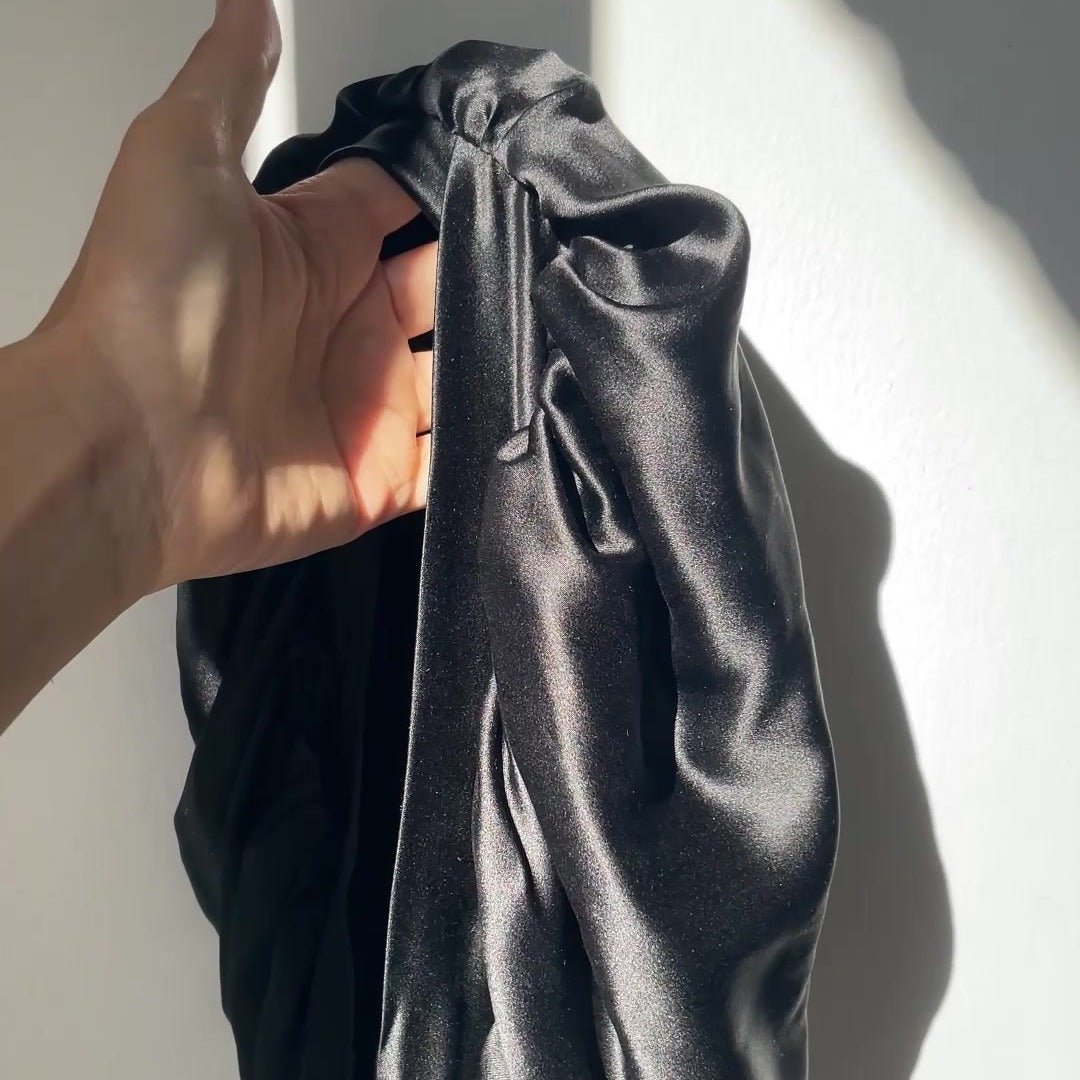
The Silk Bonnet

- Upcycled silk from French fashion house offcuts
- Adjusts to any head size and stays in place overnight
- Elegant crossover design inspired by lingerie
- Limited editions: your colorway is often one of a kind
- Handmade in France
1, 2, 3 Curly!